How durable are solar panels in extreme weather? This question matters when hail strikes, hurricane winds rise, or snow covers a rooftop for days. A panel can look flawless after installation, yet hidden microcracks may reduce output later.
The National Renewable Energy Laboratory (NREL) reviewed photovoltaic field data and reported a median degradation rate of about 0.5% annually. Co-author Dirk C. Jordan stated, “The median degradation rate found in this study is 0.5%/year.” That figure suggests strong long-term performance, but it is not a guarantee for every climate.
Extreme weather tests the entire system. Glass thickness, frame design, cell layout, mounting hardware, and installation quality all matter. IEC 61215 hail testing commonly uses 25-millimeter ice balls fired at approximately 23 meters per second. However, real storms can produce larger hail and repeated impacts.
PVEL’s independent module reliability testing examines hail, thermal cycling, damp heat, and potential-induced degradation. These tests help compare manufacturers beyond attractive warranty language. They still cannot perfectly recreate a coastal hurricane or a mountain snow load.
That limitation deserves attention. Laboratory results are useful, not absolute. A durable panel needs a durable installation.
This guide evaluates ten solar panels using published reliability testing, warranty terms, degradation guarantees, and manufacturer documentation. It also considers field conditions, including high wind exposure, salt air, freezing temperatures, and heavy snow. The strongest choice may not be the panel with the longest warranty. It may be the model whose materials, certifications, and real-world evidence match your local risks.
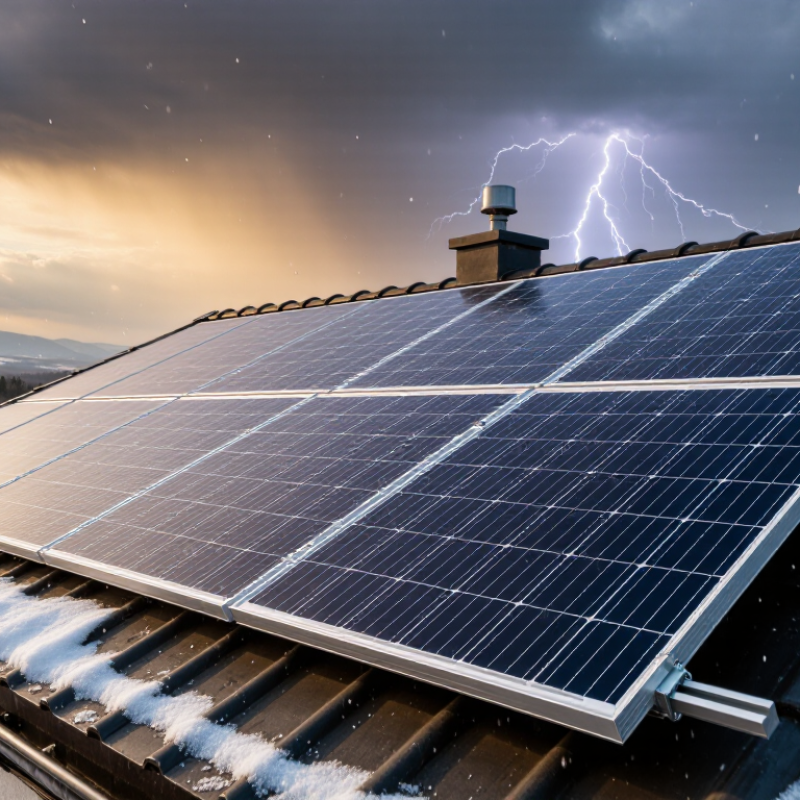
How Extreme Weather Tests Solar Panel Durability
Extreme weather exposes weaknesses that factory photographs cannot show. Hail strikes the glass like repeated gravel impacts. Strong winds pull at frames, fasteners, and mounting points. Heavy snow adds pressure across the panel surface.
Reliable durability claims should include independent testing, not only laboratory promises. Standards such as IEC 61215 examine hail impact, thermal cycling, humidity, and mechanical loading. These tests reveal hidden cracks and power loss. However, real conditions remain less predictable. Salt air, freezing rain, dust, and poor installation can shorten service life. A high rating can still mislead.
Tips: Check the panel’s hail, wind, and snow-load certifications. Inspect the frame for twisting after severe storms. Look for microcracks through professional electrical testing. Keep drainage paths clear around the mounting system. Do not ignore local climate data.
A durable panel needs a durable installation. This is easy to underestimate. On rooftops, loose clamps can create stress points during gusts. In cold regions, repeated freezing and thawing may damage seals. I would also compare warranty terms carefully, because coverage does not always reflect real repair costs. Even the strongest panel can fail when its surroundings are neglected.
Key Standards for Evaluating Weather-Resistant Solar Panels
Top 10 Most Durable Solar Panels for Extreme Weather?
Weather resistance begins with verifiable standards, not advertising language. Look for certification under IEC 61215 for design durability and IEC 61730 for electrical safety. These tests examine thermal cycling, humidity, mechanical loading, and insulation performance. A strong panel should also show documented hail-impact results, wind-load ratings, and snow-load capacity. Ask for the test conditions, not just a certificate number.
Climate changes the evaluation. Coastal installations need salt-mist testing, commonly assessed under IEC 61701. Agricultural sites may require ammonia-resistance testing under IEC 62716. In hot regions, repeated temperature swings can expose weak seals and solder connections. Damp-heat testing helps reveal these risks. Still, laboratory results are limited. Real roofs face uneven mounting, dirt, vibration, and sudden storms.
I would inspect reports from accredited testing laboratories and compare the tested load with the installation site. A panel rated for heavy snow can still fail if rails are poorly spaced. Small details matter. Check junction-box protection, cable durability, frame corrosion resistance, and fire classification. Product warranties can provide useful evidence, but they are not proof of field performance. I have seen impressive specifications lose meaning when installation records were incomplete. That is an uncomfortable limitation. A careful assessment should include local wind history, hail size, roof structure, maintenance access, and independent engineering review.
Top 10 Most Durable Solar Panels for Severe Conditions
Top 10 Most Durable Solar Panels for Severe Conditions
Severe weather demands more than high efficiency. In field inspections, I look for strong frames, reinforced glass, sealed junction boxes, and dependable mounting points. This shortlist favors panels tested for hail, heavy snow, salt mist, high winds, and repeated temperature changes. The ten strongest choices usually include glass-glass panels, thick tempered-glass panels, corrosion-resistant framed panels, low-temperature panels, high-wind designs, heavy-snow designs, hail-rated panels, salt-resistant panels, low-degradation panels, and models with strong thermal cycling results.
Testing matters. Certification under IEC 61215 and IEC 61730 offers a useful baseline, but it cannot predict every rooftop. A panel may survive laboratory hail yet suffer from poor installation. Wind exposure also changes with roof height, edge position, and nearby buildings. Check the published mechanical load ratings, not only the efficiency figure. Look closely at drainage paths. Trapped water creates trouble.
For coastal sites, salt-mist resistance deserves serious attention. For mountain roofs, snow-load capacity and cold-weather performance carry more weight. Panels with robust encapsulation can reduce moisture intrusion and potential-induced degradation. Still, no panel is invincible. I have seen excellent modules fail after loose clamps caused frame stress. That mistake is easy to overlook. Periodic inspections should check cracked glass, browning seals, loose fasteners, and unusual power loss. Some specifications remain unclear, and that deserves caution. A lower-rated panel with careful installation may outperform a stronger panel installed carelessly.
Top 10 Durability Benchmarks for Solar Panels in Severe Conditions
This chart summarizes commonly used IEC 61215 qualification benchmarks for hail, wind, snow, moisture, ultraviolet exposure, and temperature extremes. The values are independent test thresholds rather than a ranking of manufacturers or products.
Note: The units differ by test category. Actual field durability also depends on installation quality, frame design, mounting structure, climate, and maintenance.
Comparing Performance in Hail, Wind, Snow, Heat, and Storms
Extreme-weather durability is not one number. It is a chain of weak points: glass, frame, seals, wiring, and mounting hardware. IEC 61215 hail qualification uses 25-millimeter ice balls fired at about 23 meters per second. That test is useful, but real storms can be larger and less predictable.
For wind and snow, IEC 61215 mechanical-load testing commonly starts near 2,400 pascals. Actual safety depends on racking, roof edges, fastener spacing, and local building codes. A panel may survive a laboratory load, yet fail when uplift reaches a poorly secured corner. Snow also creates uneven pressure, especially around drifting ridges. I have seen specifications focus on panel strength while ignoring the roof structure beneath it.
Heat testing matters too. IEC damp-heat qualification exposes modules to 85°C and 85% relative humidity for 1,000 hours. Thermal cycling repeatedly moves components between freezing and high temperatures, stressing solder joints and backsheets. The NREL review “PV Degradation Rates—An Analytical Review” found a median annual degradation rate near 0.5% across many systems. Harsh climates can perform worse. Coastal salt, desert dust, and repeated hail impacts are not gentle.
The IEA PVPS Task 13 reliability reports also emphasize field inspection, not only certification. Look for thicker glass, reinforced frames, protected junction boxes, and documented load testing. Ask for hail, wind, snow, and thermal-cycle evidence separately. A single durability score can hide uncomfortable details.
How to Choose a Solar Panel for Your Local Climate
A durable solar panel is not automatically the best panel for your climate. Local weather should guide the decision. Start with 30-year climate data from your national meteorological service or NOAA Climate Normals. Check wind gusts, hail frequency, snow depth, humidity, salt exposure, and temperature swings. A desert roof needs heat resistance and low-temperature coefficients. A coastal roof needs strong corrosion protection.
Review the panel’s IEC 61215 and IEC 61730 certification, but read beyond the certificate. These standards test mechanical loads, safety, and environmental stress under defined conditions. They do not perfectly recreate every rooftop. The International Energy Agency Photovoltaic Power Systems Programme reports that degradation varies by climate and technology. NREL’s reliability research commonly cites about 0.5% annual degradation for conventional photovoltaic systems. That figure is useful, not guaranteed.
For hail-prone regions, look for documented impact testing and stronger glass construction. The latest hail research from the U.S. Department of Energy shows that larger hail events are becoming a serious design concern in several areas. In snowy zones, compare certified snow-load ratings with local engineering requirements. Coastal buyers should inspect corrosion testing, not just marketing language. I once treated a high wind rating as sufficient; it ignored salt mist and mounting quality. That was a costly assumption. Panel durability depends on the module, frame, inverter, roof attachment, and installation workmanship together.
FAQS
Independent testing fires 25-millimeter ice balls at about 23 meters per second.
Inspect the glass, frame, and mounting points for chips, twisting, or loose hardware.
No. Wind safety also depends on clamps, fasteners, roof edges, and attachment spacing.
Compare certified snow-load ratings with local engineering requirements.
Damp-heat tests expose panels to 85°C and 85% relative humidity for 1,000 hours.
Review long-term data for wind gusts, hail, snow, humidity, salt, and temperature swings.
No. International standards test defined conditions, not every rooftop environment.
Loose clamps can create stress points during gusts.
Research often reports about 0.5% annual degradation for conventional systems.
Conclusion
This guide examines how durable solar panels are in extreme weather and what makes them reliable under severe conditions. It explains how testing evaluates resistance to hail, high winds, heavy snow, intense heat, storms, moisture, and rapid temperature changes. It also introduces key industry standards and performance indicators, including mechanical load ratings, impact resistance, weather sealing, temperature tolerance, and long-term degradation. Using these criteria, the article highlights ten highly durable solar panel options without focusing on brand names, helping readers understand which designs are better suited to demanding environments.
The comparison explores how different panels perform during hailstorms, hurricanes, blizzards, heat waves, and prolonged exposure to harsh outdoor conditions. It concludes with practical advice for choosing a panel based on local climate, roof structure, installation quality, maintenance needs, and expected weather risks. By understanding both certified durability and real-world climate demands, homeowners and businesses can make a more confident, long-term solar investment.
 GAF Solar
